We had our first joint work session on the Shoreline Management Program with the Planning and Parks & Arts Commissions tonight. The Planning Commission will be doing more work on the plan in the next year, with public hearings at City Council planned for February and March in 2011.
The Planning Department has lots of information available at the city's shorelines website.
The shoreline program is important for our waterfront, including Lighthouse Park and the tank farm redevelopment. It’s not as critical for most homeowners in the city: our steep slopes at the waters’ edge means that most homes are outside of the 200 feet of management zone where the Shoreline Management Program will be (and has been) in effect.
The shoreline plan also is being designed to account for the potential annexation areas (more marine shoreline, and Lake Serene).
This plan process is a valuable opportunity to ensure regulations use the best science, protect our environment and ensure water uses and public access are continually allowed and improved.
Showing posts with label growth.. Show all posts
Showing posts with label growth.. Show all posts
Tuesday, June 15, 2010


Monday, May 24, 2010
Annexation
We had an interesting discussion about annexation tonight at Council. We don’t take votes at work sessions, and this was meant to be informational. I’m not sure where all the council members are at on this—I guess we will find out in the coming weeks. It does seem like there may still be four votes to move the issue forward.
The staff has prepared a timeline that would take us to the Boundary Review Board (BRB) either in September this year, or February 3, 2011. It’s available here.
We expect the result, assuming it’s affirmative, would be appealed again by Fire District One. They appealed the last decision of the BRB, which brought us to this point of re-set. With that timeline and contingencies, it would take us into 2012 for the annexation to be in effect. With that timeline, we will also turn to our current residents in Mukilteo to discuss, or possibly to vote on, the issue. There are a variety of election dates after the potential BRB decision and before any vote inside the annexation area. Once the BRB decision is rendered, and any appeals are settled, it makes sense to ask Mukilteo voters: that’s when we’ll have a full picture of what we’re asking, both inside and outside the current city limits.
The discussion about annexation is happening in the framework of another process, our adoption of a long-range financial plan. That plan is taking the shape of a variety of policies governing the city’s finances. We also have a workshop to discuss a vision for the future of Mukilteo scheduled for June 10th. I’m excited for that opportunity to talk about a host of issues facing Mukilteo, and to envision what shape the future may take.
One other topic that came up was the zoning for the manufactured home communities inside the annexation area: the biggest one is Carriage Club Estates. Most of the councilmembers present voiced an interest in adopting a manufactured home park zone, similar to what the County has in place now for those properties. This is great news for the residents of Carriage Club, and I'm glad more of the council now shares my interest in taking this action.
The staff has prepared a timeline that would take us to the Boundary Review Board (BRB) either in September this year, or February 3, 2011. It’s available here.
We expect the result, assuming it’s affirmative, would be appealed again by Fire District One. They appealed the last decision of the BRB, which brought us to this point of re-set. With that timeline and contingencies, it would take us into 2012 for the annexation to be in effect. With that timeline, we will also turn to our current residents in Mukilteo to discuss, or possibly to vote on, the issue. There are a variety of election dates after the potential BRB decision and before any vote inside the annexation area. Once the BRB decision is rendered, and any appeals are settled, it makes sense to ask Mukilteo voters: that’s when we’ll have a full picture of what we’re asking, both inside and outside the current city limits.
The discussion about annexation is happening in the framework of another process, our adoption of a long-range financial plan. That plan is taking the shape of a variety of policies governing the city’s finances. We also have a workshop to discuss a vision for the future of Mukilteo scheduled for June 10th. I’m excited for that opportunity to talk about a host of issues facing Mukilteo, and to envision what shape the future may take.
One other topic that came up was the zoning for the manufactured home communities inside the annexation area: the biggest one is Carriage Club Estates. Most of the councilmembers present voiced an interest in adopting a manufactured home park zone, similar to what the County has in place now for those properties. This is great news for the residents of Carriage Club, and I'm glad more of the council now shares my interest in taking this action.
Monday, May 3, 2010
Countywide Vision

Last week, I attended a discussion about countywide planning policies at Snohomish County Tomorrow’s Steering Committee (SCT). SCT is a body of elected officials in the county who advise on vision and frameworks for the future of Snohomish County. Often, that results in sending direction or advisory motions to the County Council for their consideration. It might also result in advocacy for certain policy ideas.
The Countywide Planning Policies are an important piece of growth management policies in the region. All the different comprehensive plans and planning policy documents link together, from the city level up to the state level. This review of these countywide policies is a ten-year update to the policies. The image attached shows how these policies are linked and supportive of other regional planning policies.
As you might imagine, I love this stuff. It’s exciting to see the opportunities to shape the vision of the county’s future, to consider new ideas.
At this particular meeting, we discussed proposed policies for Development Pattern Policies. The materials on the topic are available here.
Some of the more controversial policies (the ones with minority and majority views from the technical advisory committee that is working on drafting the policies) relate to expanding urban growth areas. This doesn’t relate to Mukilteo directly because our urban growth area (areas outside the city that could and probably will be annexed someday) are all contiguous with other such areas. In cities like Snohomish, Lake Stevens, Marysville, and other cities in the north, their urban growth areas abut rural lands. So, at certain times, these cities or landowners might ask the county to expand the urban growth area, which allows more development in these rural areas.
There are some divided opinions on when this should be allowed. Snohomish County has been challenged by the regional goals of keeping future growth in urban areas, and keeping rural areas rural. The County has improved over the last few years. I think it makes sense to keep pushing that line and not provide many exceptions for expanding the urban growth areas.
This is an issue that will come back to Snohomish County Tomorrow in May and later in the year, as well, with the Steering Committee likely voting in late fall. Eventually, these policies will be adopted by the County Council.
Tuesday, March 16, 2010
Envisioning a New Future
I recently studied the oldest building in Mukilteo, which was built in 1904. The Smith family who lived and worked at 801 Second Street were part of an America where 8000 cars were owned in the early 1900’s. Twenty years later, there were 10 million cars in America. Every state had a highway department. America changed drastically in those twenty years.
Today, our country demands similar changes and choices for the future. We have to invest in these options, for housing choices, transportation options, efforts to create sustainable, livable communities, economic development, and a better future. At today’s National League of Cities session on Sustainable Development, Beth Osborn, Deputy Assistant Secretary for Policy at the U.S. Department of Transportation described livable communities as places “where people at all stages of life can live close to one another.” It’s really inspiring that the US Department of Transportation understands and is working with the Department of Housing and Urban Development and the Environmental Protection Agency on these issues. Connecting housing and destinations to transportation planning is so important. Mukilteo needs to do the same wherever we can.
At another session here, U.S. Secretary of Transportation Ray LaHood talked about the need to not force people into communities where the car is a necessity rather than a convenience. That is such an important distinction. I have heard fears about government forcing people to get out of their cars. It’s more about investing in other transportation modes the way we have subsidized car ownership and infrastructure for nearly a century. It’s about giving people choices.
Today, our country demands similar changes and choices for the future. We have to invest in these options, for housing choices, transportation options, efforts to create sustainable, livable communities, economic development, and a better future. At today’s National League of Cities session on Sustainable Development, Beth Osborn, Deputy Assistant Secretary for Policy at the U.S. Department of Transportation described livable communities as places “where people at all stages of life can live close to one another.” It’s really inspiring that the US Department of Transportation understands and is working with the Department of Housing and Urban Development and the Environmental Protection Agency on these issues. Connecting housing and destinations to transportation planning is so important. Mukilteo needs to do the same wherever we can.
At another session here, U.S. Secretary of Transportation Ray LaHood talked about the need to not force people into communities where the car is a necessity rather than a convenience. That is such an important distinction. I have heard fears about government forcing people to get out of their cars. It’s more about investing in other transportation modes the way we have subsidized car ownership and infrastructure for nearly a century. It’s about giving people choices.
Saturday, August 9, 2008
a real park on the waterfront
Today was the grand opening of Lighthouse Park, phase one! It was a sunny, warm, if a little windy, day. All the new facilities look great. The pathways are pleasant, kids' toys were well-used, and the new berm and beach plantings make it look like a real thriving piece of Puget Sound.
The turn out was great-- lots of citizens, electeds, city staff.
My favorite part was when the ribbon had been cut by former Councilmember Bruce Richter and Mayor Marine, and the play area was opened up. A couple little girls made a run for the commemorative sand pails, collecting a couple for themselves. Later, when my sister arrived, we wished we could have made the same mad dash to retrieve one of the buckets. We settled for a couple toy wind mills.
It was a triumphant day for the community, opening up great new amenities. The phase one park renovations cost about $3million, with about $800,000 in state grants. Don't quote me on that-- but I think that's about right. Now, our attentions will turn to the design of phase two, the entrance to the park, and identifying grants and city funds to keep the ultimate vision for Lighthouse Park moving along.
The turn out was great-- lots of citizens, electeds, city staff.
My favorite part was when the ribbon had been cut by former Councilmember Bruce Richter and Mayor Marine, and the play area was opened up. A couple little girls made a run for the commemorative sand pails, collecting a couple for themselves. Later, when my sister arrived, we wished we could have made the same mad dash to retrieve one of the buckets. We settled for a couple toy wind mills.
It was a triumphant day for the community, opening up great new amenities. The phase one park renovations cost about $3million, with about $800,000 in state grants. Don't quote me on that-- but I think that's about right. Now, our attentions will turn to the design of phase two, the entrance to the park, and identifying grants and city funds to keep the ultimate vision for Lighthouse Park moving along.
Tuesday, August 5, 2008
drive aisles drive ways drive drive drive
We finished the Roadways and Internal Vehicle Access code last night. It was interesting-- whenever a councilmember is gone and we have a controversial ordinance, it makes it that much harder. The ordinance needed four votes to pass, and with Kevin and Tony voting no, it had that.
I feel like we did the right thing-- it was a complex code, but we need the definitions of drive aisles that were added.
We didn't address traffic, for a reason-- that depends on site specific issues and we have many different ways to address those during other stages of development approval. Our professional staff, public works director, planning director, fire marshal, have opportunities to add conditions to projects almost unilaterally. The SEPA process allows for mitigation of impacts. If a development agreement is used, the city can add conditions that are more strict than the code and ask for specific improvements. Rezones can be approved with conditions. The City Council doesn't always have the chance to be involved in that discussion (such as the staff review, development agreement negotiation, SEPA approvals), but the city has the tools and uses them all the time.
It was also interesting to me to see the connections with the county's LDMR code. In our case, all those extras that aren't mandated in the code-- sidewalks, driveway space in front of attached-garages-- make for difficult living situations. Those have cropped up (or not shown up) in developments in the county that look very similar to single family developments without the amenities needed. In Mukilteo, we have Island View Ridge, high-value condos that have great views (probably have gorgeous interiors, I would assume), priced very high, but with the same lack of driveway space, sidewalks, etc. We need to address those items in future developments. Planning staff said they would bring all that back to us before annexation. That's a good thing.
I feel like we did the right thing-- it was a complex code, but we need the definitions of drive aisles that were added.
We didn't address traffic, for a reason-- that depends on site specific issues and we have many different ways to address those during other stages of development approval. Our professional staff, public works director, planning director, fire marshal, have opportunities to add conditions to projects almost unilaterally. The SEPA process allows for mitigation of impacts. If a development agreement is used, the city can add conditions that are more strict than the code and ask for specific improvements. Rezones can be approved with conditions. The City Council doesn't always have the chance to be involved in that discussion (such as the staff review, development agreement negotiation, SEPA approvals), but the city has the tools and uses them all the time.
It was also interesting to me to see the connections with the county's LDMR code. In our case, all those extras that aren't mandated in the code-- sidewalks, driveway space in front of attached-garages-- make for difficult living situations. Those have cropped up (or not shown up) in developments in the county that look very similar to single family developments without the amenities needed. In Mukilteo, we have Island View Ridge, high-value condos that have great views (probably have gorgeous interiors, I would assume), priced very high, but with the same lack of driveway space, sidewalks, etc. We need to address those items in future developments. Planning staff said they would bring all that back to us before annexation. That's a good thing.
Thursday, July 31, 2008
tent city
A couple weeks ago, our council passed an ordinance that helps regulate potential homeless encampments. We don't have any expectation of a tent city coming to Mukilteo, but it's a good idea to be prepared. This way, we have a code that sets expectations and requirements. Were an organization to decide to bring a tent city to Mukilteo, we wouldn't first have to go to court. Instead, we could follow the conditional use permit process, which allows for public hearings, conditions to be applied, and specific communication and security in place for the encampment. It's a good thing to be prepared.
Monday, July 14, 2008
bikes & peds in Muk
For whatever reason, I didn't realize how much our trail plan really addresses bicycling and pedestrian issues. It's great to see the accounting of existing infrastructure and encouragement of future improvements. However, providing facilities isn't the only way to encourage biking and walking in the city. It would be nice to see some elements addressing encouragement and education related to biking and walking.
Publishing a bike map?
Creating walking routes?
Marketing active bikers and walkers in neighborhoods (let's tell the Lord's family story-- bike commuters, bike tourists....)?
Working with schools to educate young bikers and walkers?
Publishing a bike map?
Creating walking routes?
Marketing active bikers and walkers in neighborhoods (let's tell the Lord's family story-- bike commuters, bike tourists....)?
Working with schools to educate young bikers and walkers?
Sunday, July 6, 2008
ColoradoJune2008


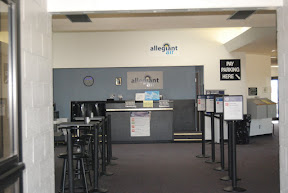
Fort Collins Loveland Airport has one airline providing commercial flights. That airline is Allegiant Air.
Their terminal is fairly small. Inside, it has the basics of an airport:
The baggage claim is just to the right of the terminal-- outside.
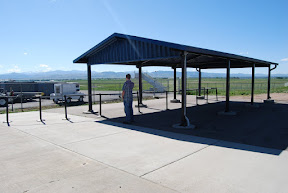
This looks like it could appear at Paine Field easily. However, there's another angle to consider. Check out what surrounds the airport for at least 3 miles:

Not very similar to the issues in Mukilteo:
View Larger Map
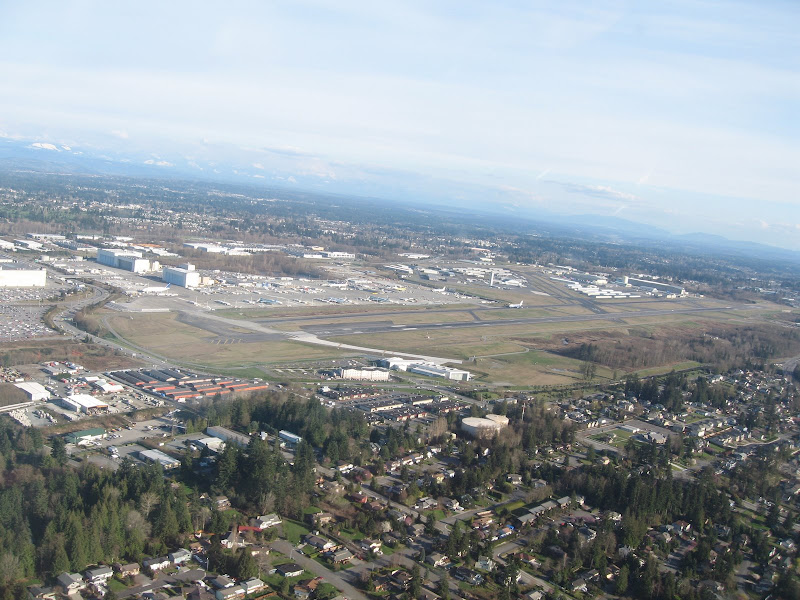
My recent trip to Colorado was interesting to see what perspective Allegiant Air likely has. They have a small lo-fi terminal, not many amenities, in an airport that is about an hour and a half from Denver, providing mostly vacation package trips to Vegas.
Fort Collins Loveland Airport had quite a few other uses-- aerospace industry type uses. It certainly didn't look like the ability to get to the Bellagio Hotel quickly was bringing business in. I don't think economic development could at all be considered a result of the addition of commercial service.
If Snohomish County's goal is to get our residents to Circus Circus as fast as we can... Well, the solution is clear.
If we want to expand high quality aerospace jobs, continue to improve our quality of life and have choices for getting to the airport quickly-- that doesn't include putting the airport in your backyard. It's about transportation choices on the ground. The Allegiant Air model won't be a good one for Snohomish County.
Wednesday, June 25, 2008
snohomish county tomorrow
Interesting meeting tonight. I missed the very beginning, but heard about the Sound Transit potential proposal for the November ballot from Greg Walker, their Chief Planning Officer. Take aways were that Mukilteo needs to send a letter to our ST board members by July 10th if we want to have any input at all. Plus, that this new iteration is smaller (either 0.4 or 0.5 %) and it won't get us to Lynnwood on light rail, just Northgate.Which is just no good. What we do get is a bunch of bus service, which is fine until the buses get stuck in traffic. One really great thing is that there is still money for the improvements to the Mukilteo station. I drove by today and noted that there were 47 parking spots in use, with about 15 not being used. I think that's pretty good ridership (assuming there are even more riders who walked over from the ferry!).
There is one potential scenario that gets light rail to Lynnwood, but it uses our Snohomish county money to get from Northgate to the county line (inside King County), and would do it by 2023.
We also talked about growth in the county. I learned some more about fully contained communities-- terrible planning idea. Well, a decent concept if you could actually contain and build both the residences and the jobs. Instead, you just get dense housing way out on rural roads without the infrastructure to support them. Which then puts more pressure to expand UGAs, to grow in rural areas... County Councilmember Dave Somers is doing much (with Councilmembers Sullivan and Cooper's support) to work through the process so that they are not possible anymore. Though they don't affect Mukilteo directly, this is a good thing. Anything that exacerbates our traffic situation, as these would, is a bad idea.
County Councilmember Brian Sullivan talked a bit about a few things the council is working on. Good ideas on changing their docket process: Snohomish County does it every single year, charges no fee and spends 20 county planning staff members on it. King County does it every four years, so you do two dockets before the 10 year comprehensive plan update, and they charge a fee. That helps make proposals be more well thought out and more likely to actually make sense.
He also talked about the Manufactured Home Community Preservation Subcommittee. That's the one that Diane Navicky sits on. The outcomes of that process that he mentioned included incentives for local options, a process to be permanently zoned as a manufactured home park. I'll be interested to see what happens. It seems that there are definitely some legal constraints to deal with, but I love the concept. Carriage Club Estates, in our proposed annexation area, is a perfect example of a lovely community providing affordable housing, a sense of community and place, and a great housing choice for residents.
He also mentioned the Justice Center proposal-- $165 million for much needed improvements to the Sheriff's office, prosecutors offices, district court, other courts... Sounds like they really need it but the idea of putting that much money on the ballot seems--- well, I wouldn't do it. I hope the county comes up with a way to save and pay for that, and only asks for a portion from taxpayers.
We discussed a few other things, but those are some highlights.
There is one potential scenario that gets light rail to Lynnwood, but it uses our Snohomish county money to get from Northgate to the county line (inside King County), and would do it by 2023.
We also talked about growth in the county. I learned some more about fully contained communities-- terrible planning idea. Well, a decent concept if you could actually contain and build both the residences and the jobs. Instead, you just get dense housing way out on rural roads without the infrastructure to support them. Which then puts more pressure to expand UGAs, to grow in rural areas... County Councilmember Dave Somers is doing much (with Councilmembers Sullivan and Cooper's support) to work through the process so that they are not possible anymore. Though they don't affect Mukilteo directly, this is a good thing. Anything that exacerbates our traffic situation, as these would, is a bad idea.
County Councilmember Brian Sullivan talked a bit about a few things the council is working on. Good ideas on changing their docket process: Snohomish County does it every single year, charges no fee and spends 20 county planning staff members on it. King County does it every four years, so you do two dockets before the 10 year comprehensive plan update, and they charge a fee. That helps make proposals be more well thought out and more likely to actually make sense.
He also talked about the Manufactured Home Community Preservation Subcommittee. That's the one that Diane Navicky sits on. The outcomes of that process that he mentioned included incentives for local options, a process to be permanently zoned as a manufactured home park. I'll be interested to see what happens. It seems that there are definitely some legal constraints to deal with, but I love the concept. Carriage Club Estates, in our proposed annexation area, is a perfect example of a lovely community providing affordable housing, a sense of community and place, and a great housing choice for residents.
He also mentioned the Justice Center proposal-- $165 million for much needed improvements to the Sheriff's office, prosecutors offices, district court, other courts... Sounds like they really need it but the idea of putting that much money on the ballot seems--- well, I wouldn't do it. I hope the county comes up with a way to save and pay for that, and only asks for a portion from taxpayers.
We discussed a few other things, but those are some highlights.
Subscribe to:
Posts (Atom)


 Posts
Posts


